All 20 mechanisms
Numbered by sustained clamp force, strongest first. 3 are for round lids only, and plain lid screws are the baseline every latch has to beat. Each page has the 3D model, parts list, print files, the worked calculation, the adversarial review and the sources.
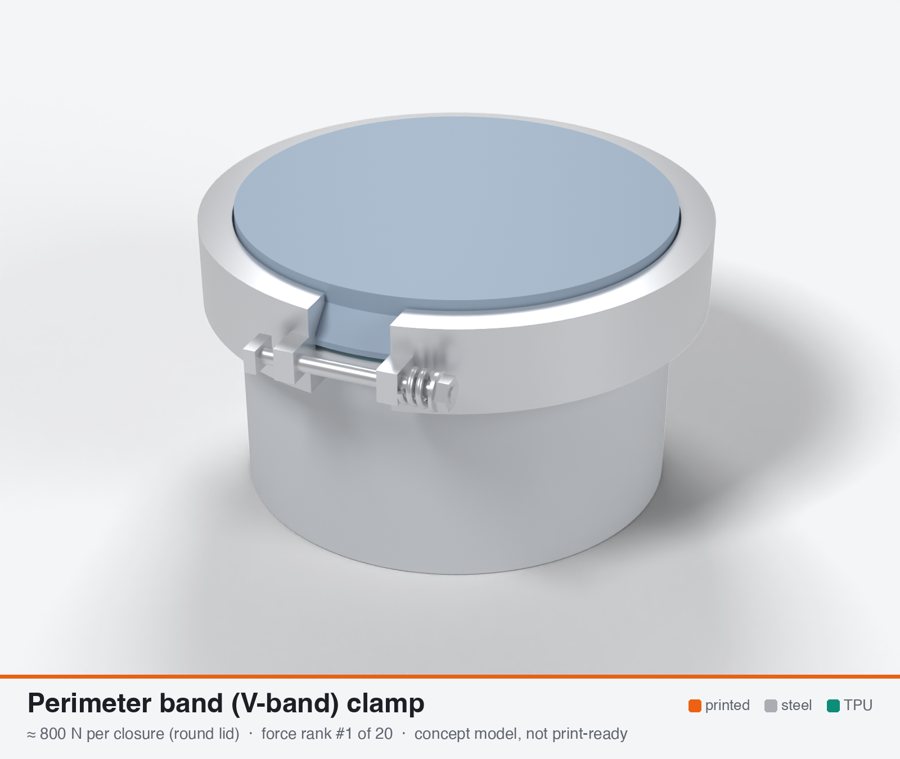
Perimeter band (V-band) clamp
Highest number but it is a whole-closure force for one steel band on a ROUND or oval lid (about 2.1 N/mm on a 377 mm path), not a per-latch force. It does not fit the 70x35x30 mm envelope or the 200x150 mm rectangle. A 10x8 mm printed ring and a spring in the T-bolt are required.
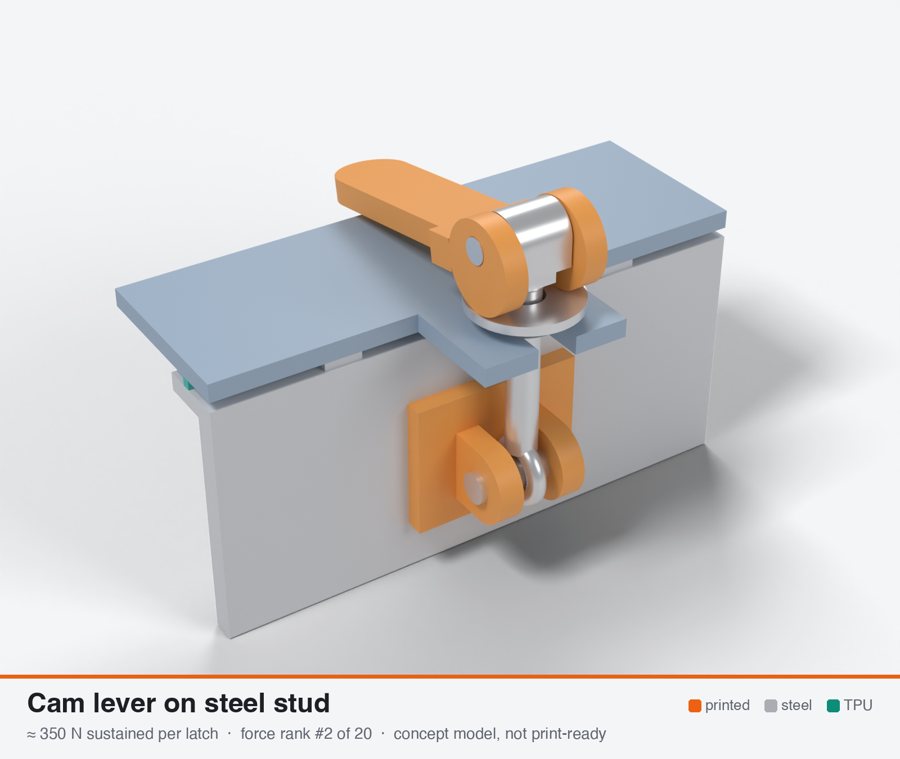
Cam lever on steel stud
Highest true per-latch force. Limits are the M5 pin bearing in 2x7 mm ears and the insert anchor in a thick ledge. A steel stud, plate and spring stack are mandatory, so it is a hybrid with a printed lever and bracket. Adjustable, with a positive stop and about 25 N hand force.
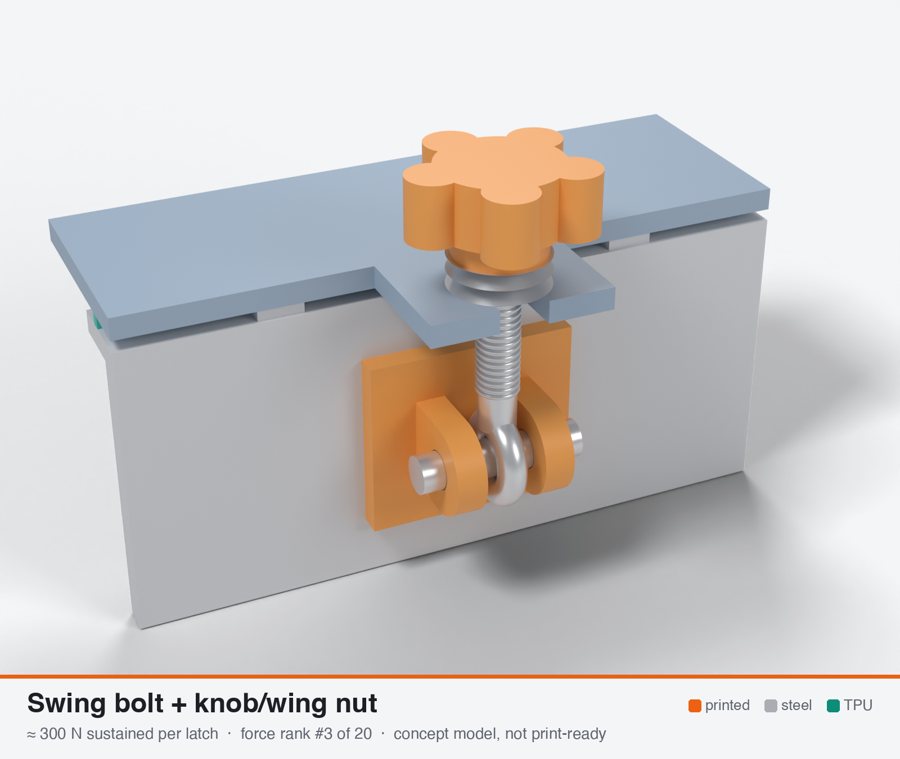
Swing bolt + knob/wing nut
Cut from 400 N because the clevis bracket anchors to the wall like a baseline screw and adds a pin joint. Torque is set by the hand, so a Belleville stack or torque-limiting knob is needed. Fully re-tensionable, but slow to operate.
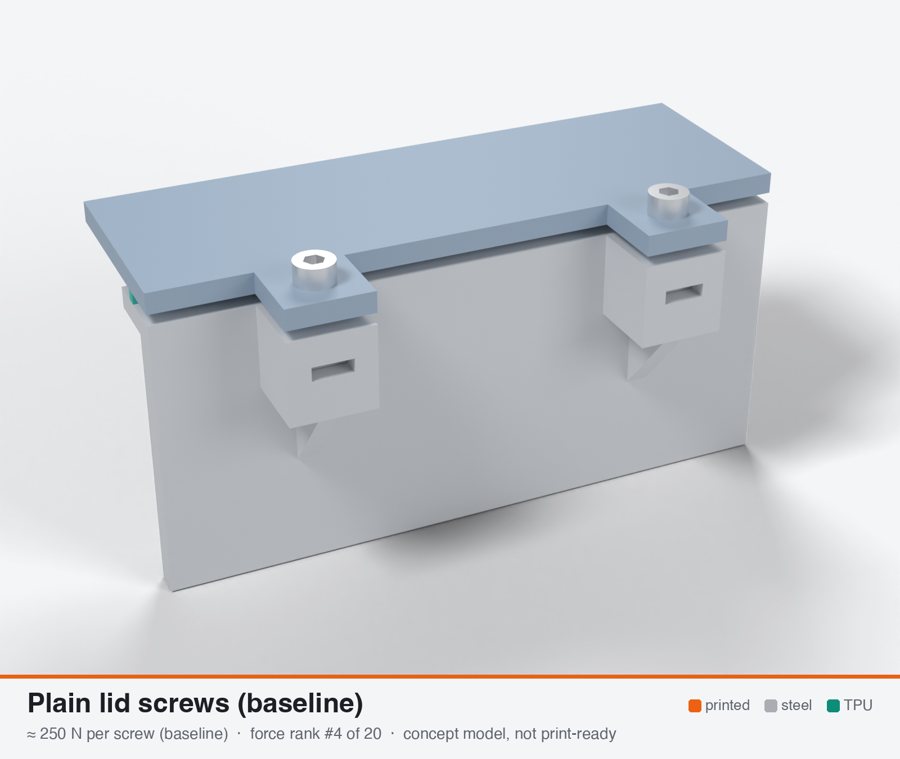
Plain lid screws (baseline)
The benchmark any printed latch must beat. Limited by insert pull-out and the washer seat in a hot boss. Durable and printable, with an inherent stop, but rigid, so 35-55 % of the force is lost after hot sun until re-tightened. Usability 3.
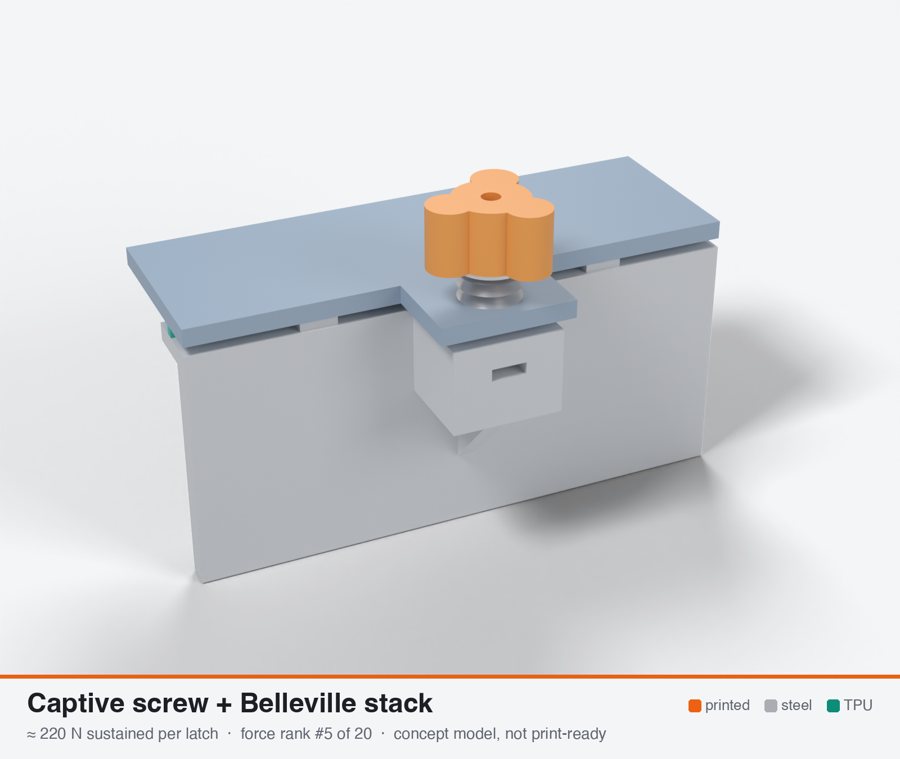
Captive screw + Belleville stack
Same boss limit as the baseline, slightly lower because a spring holds the load continuously. Best retention of the screw types (calculated about 85-95 % held after hot set, not validated) and removes most of the cold overload. Needs a die spring or Belleville stack, not a small coil.
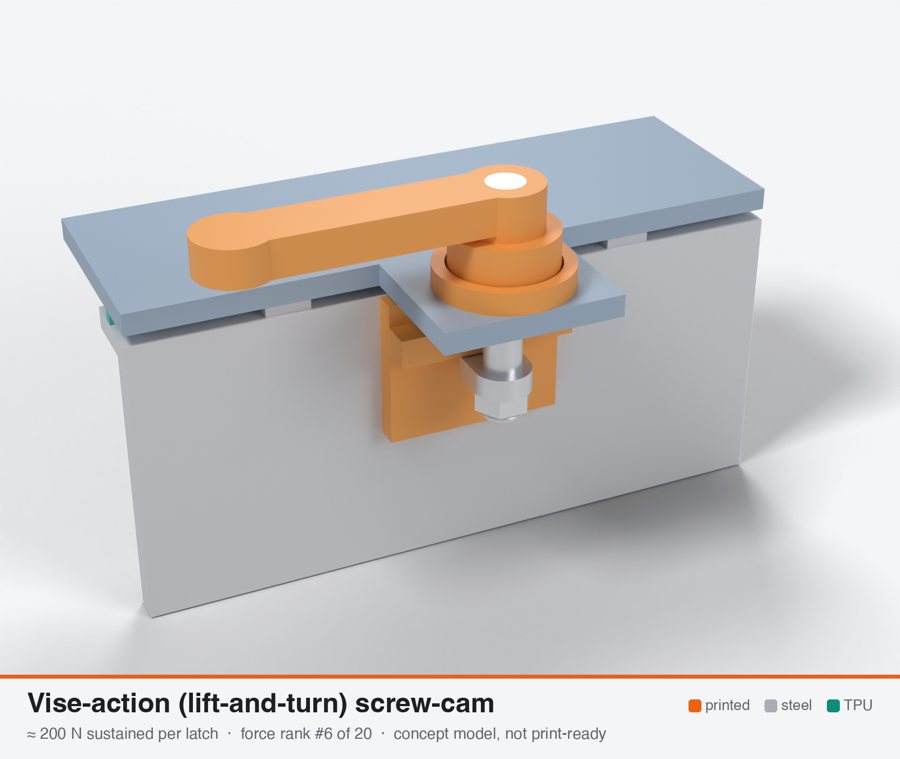
Vise-action (lift-and-turn) screw-cam
Limited by the keeper ledge loaded across layers (120-240 N). Adjustable, with a positive stop and about 22 N hand force. Printed helical ramps wear. Force scatter is about 40 % without a spring.
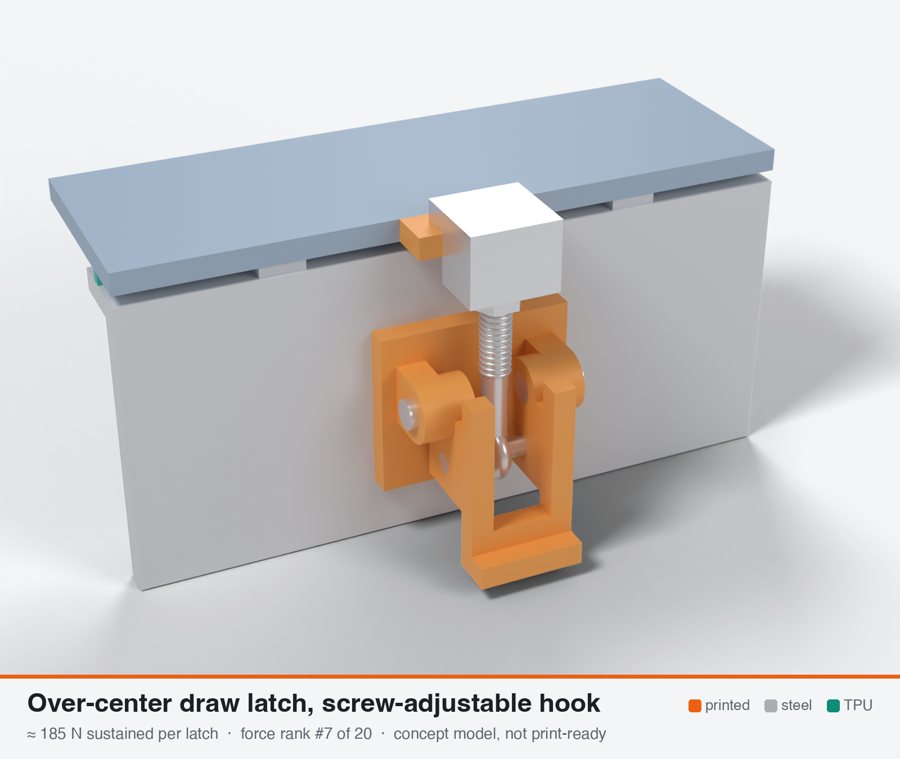
Over-center draw latch, screw-adjustable hook
Over-center lever with a steel eye-bolt adjuster. About five printed failure modes (wall bearing, pin bores, lug, ear root, keeper) sit within about 1.4x of each other. Re-tensionable (0.2 turn restores hot-set loss) and quick to operate. A rigid link, so scheduled re-tensioning is required.
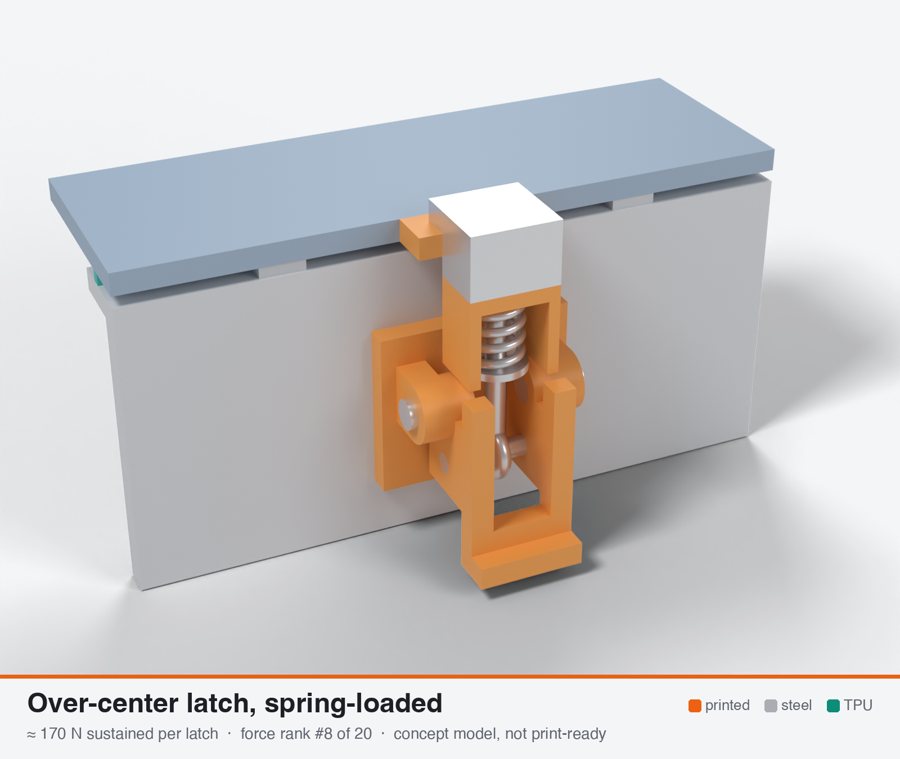
Over-center latch, spring-loaded
Same printed limits as the screw-hook version, minus a knock-down for the carriage and guides. Best end-of-life retention of the over-center types (about 92 % kept). Fit in the envelope is unproven, and the exposed spring and guide are weak outdoors.
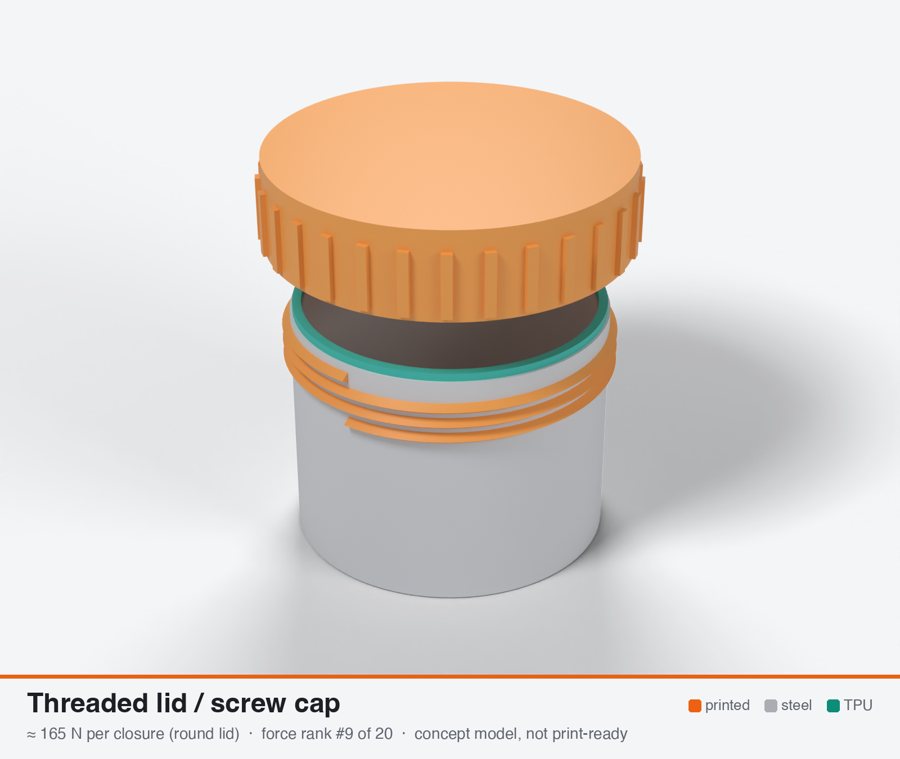
Threaded lid / screw cap
Round caps of 50 mm or less only. Force is torque-limited (about 3 Nm drives about 165 N because TPU face drag dominates). Thread-root bending across layers caps the structure near 400 N, not 1 kN. About 1 N/mm on the 157 mm ring, below the 2-4 N/mm window.
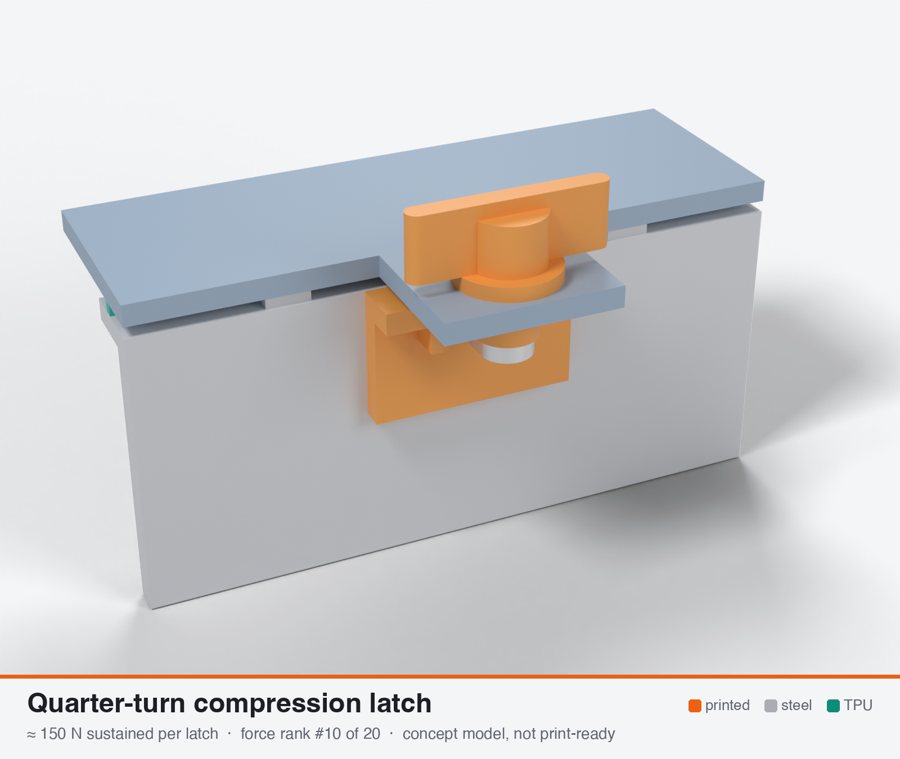
Quarter-turn compression latch
A printed pawl alone gives about 115 N. 150-350 N needs a steel pawl and a keeper. Commercial 4-6 mm ramp travel does not match the 0.5 mm gasket stroke, so force scatter is about 40 %. Better with foam or a thin rib than with the 85A design rib.
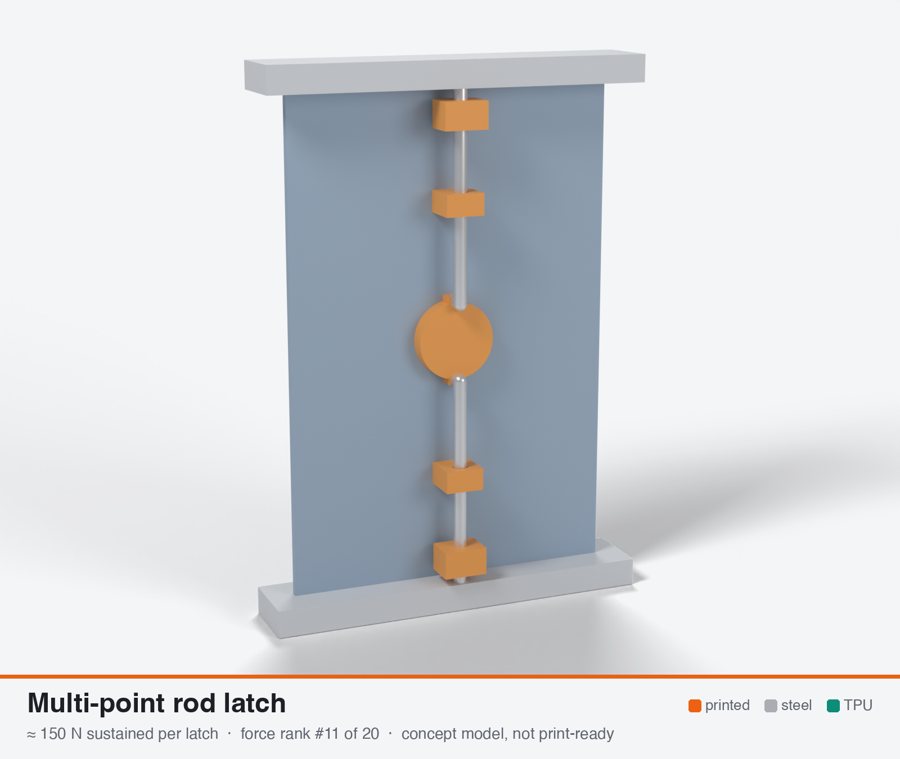
Multi-point rod latch
This is per latch POINT on a 4-point door. One handle delivers only about 0.57-0.8 kN in total before set loss, which is 0.5-1.1 N/mm. It does not fit the envelope. Rod, bellcrank and guide complexity outdoors hurts durability.
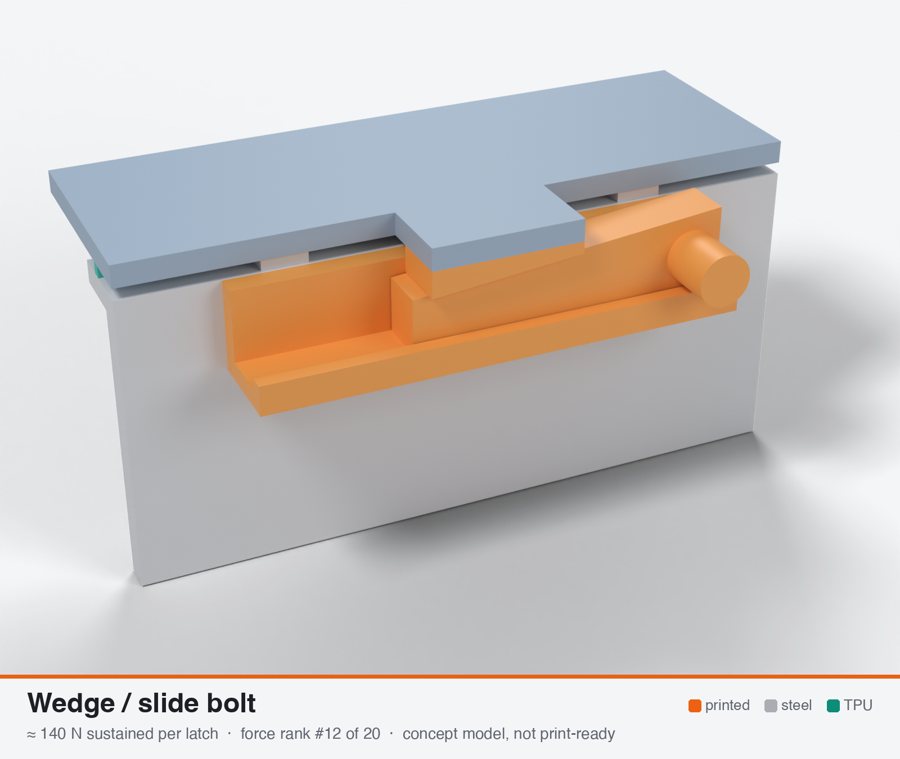
Wedge / slide bolt
Cut from 200 N to the force a reasonable push can deliver. The wedge gives excellent stroke control (10:1) and recovers hot set, but it needs a separate pivoted tab or catch block anchor. Loose wedge, fretting and ice jams are the risks.
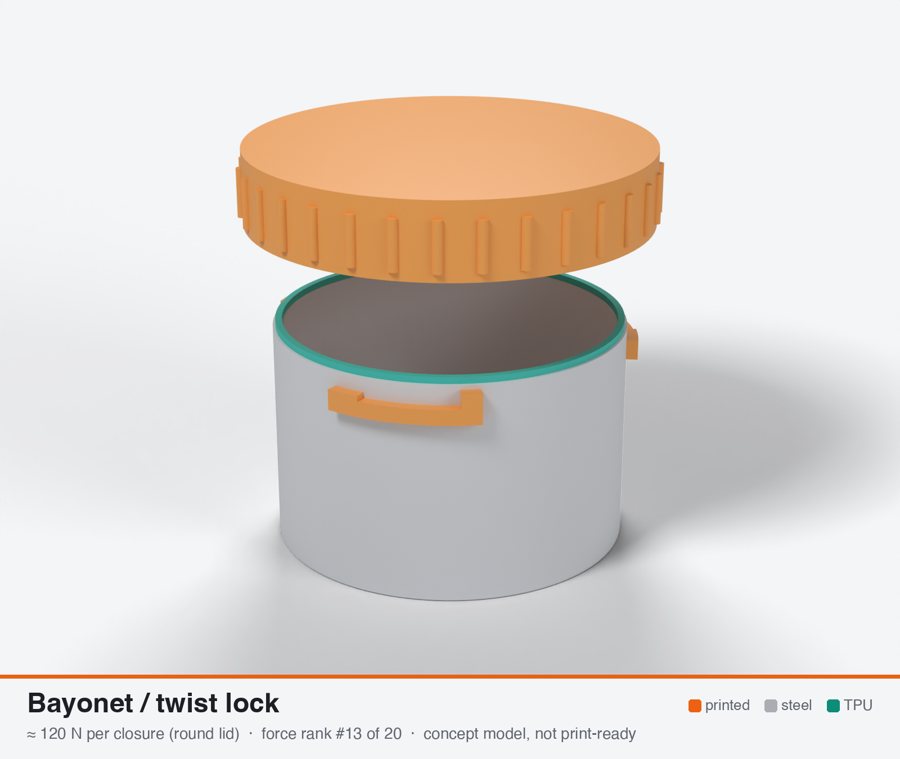
Bayonet / twist lock
Round lids only. Torque and TPU drag give 92-183 N at 2-4 Nm, and the lug roots across layers give 120-180 N. Fixed ramp height, no re-tightening, 30-58 % hot loss. About 0.7 N/mm, so it suits only small lids.
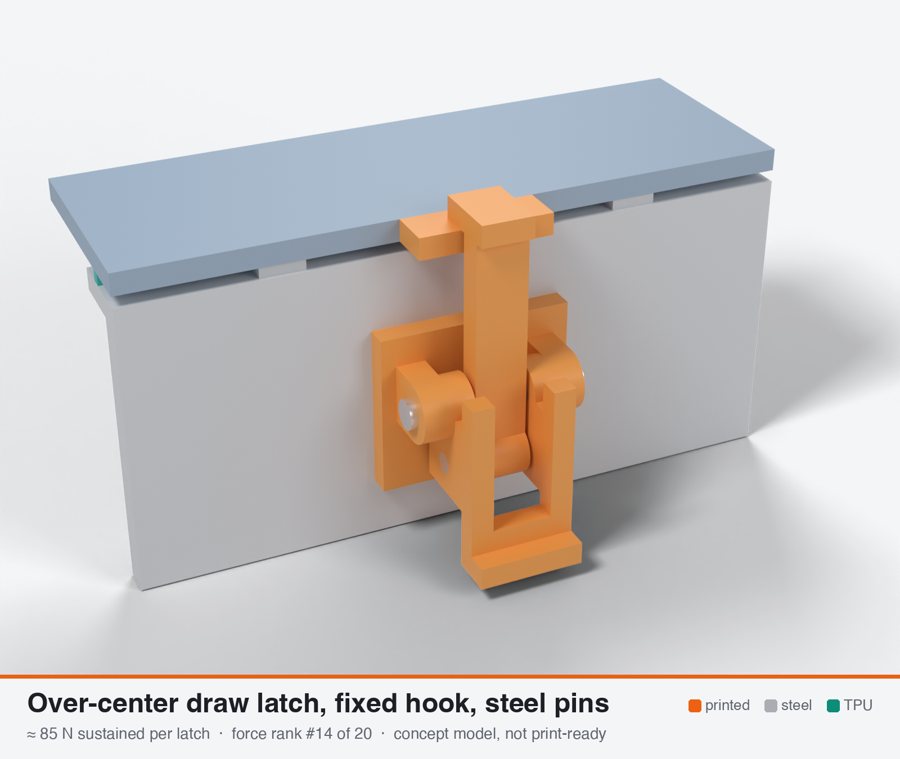
Over-center draw latch, fixed hook, steel pins
Cut from 110 N. The printed claw throat is a curved-beam limit of about 40-70 N, with a bent A4 wire hook the only route to 100 N or more. No adjustment, so +/-0.3 mm of tolerance is +/-160 N. After hot set the line load falls to about 1 N/mm or less.
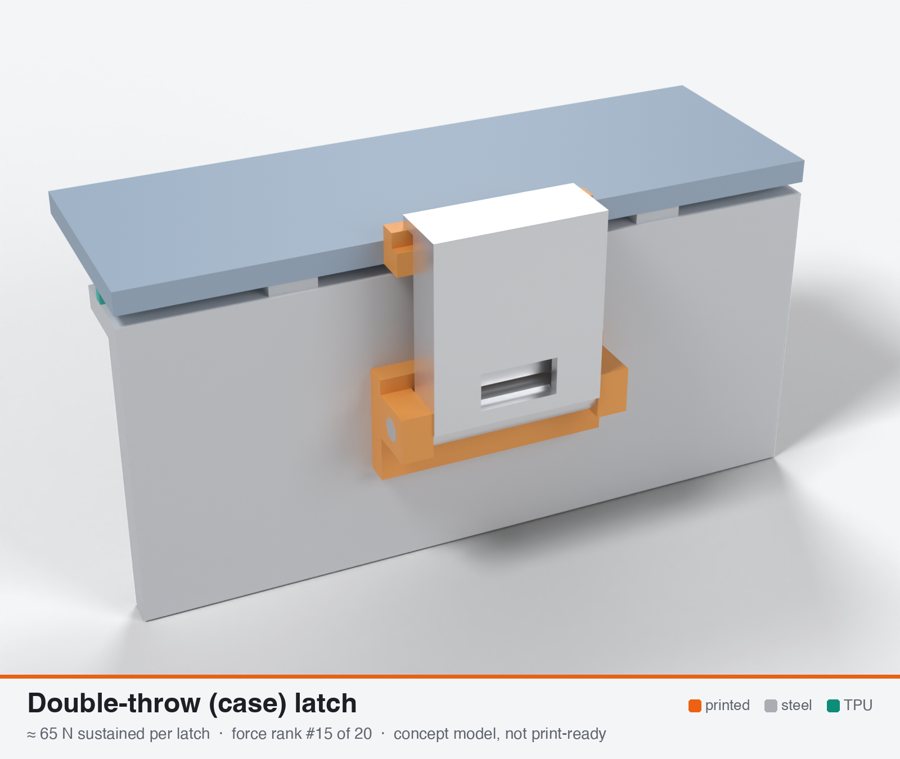
Double-throw (case) latch
The printed hook arm with 1 mm of load eccentricity holds about 45-76 N. The 90 kg figure belongs to a stamped steel latch and is not a gasket force. No stop or adjustment, and closing force depends on the finger. Cut from 85 N.
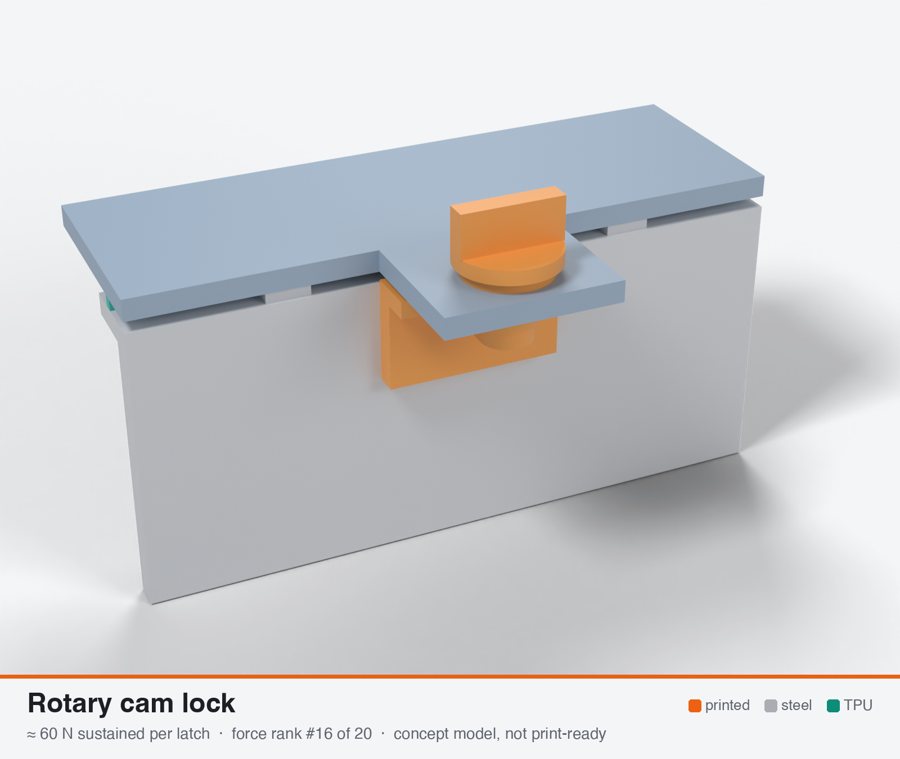
Rotary cam lock
The thumb can overload the printed tongue (165-225 N at 0.8 Nm). The tongue limits it to about 25-100 N. No stop, and no way to re-tighten. A 700 mm path would need 15-35 cams.
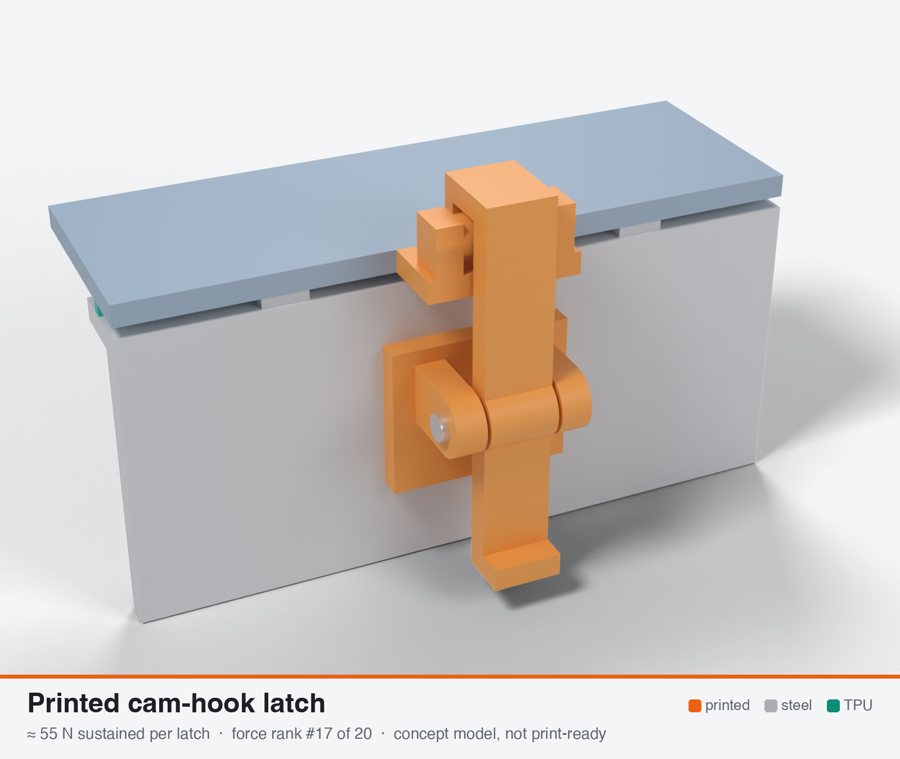
Printed cam-hook latch
Hook jaw root limited (Winkler curved beam, about 0.075-0.115 MPa/N). Fixed stroke, no spring, and the +/-0.2 mm of FDM tolerance is +/-40-100 % of the force. Fine on small boxes with a light rib. Hot creep takes 40-70 % of the force.
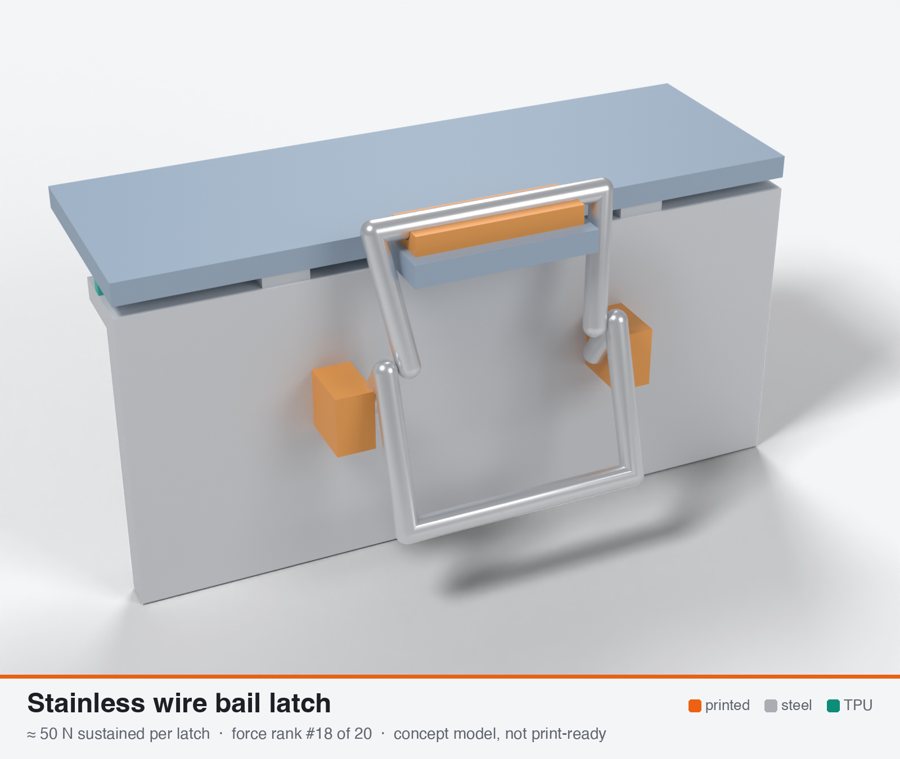
Stainless wire bail latch
The wire (steel) is not the limit. The printed catch hook is (about 7 MPa at 60 N). Good retention because the wire acts as the spring. 28-56 latches would be needed on the reference lid.
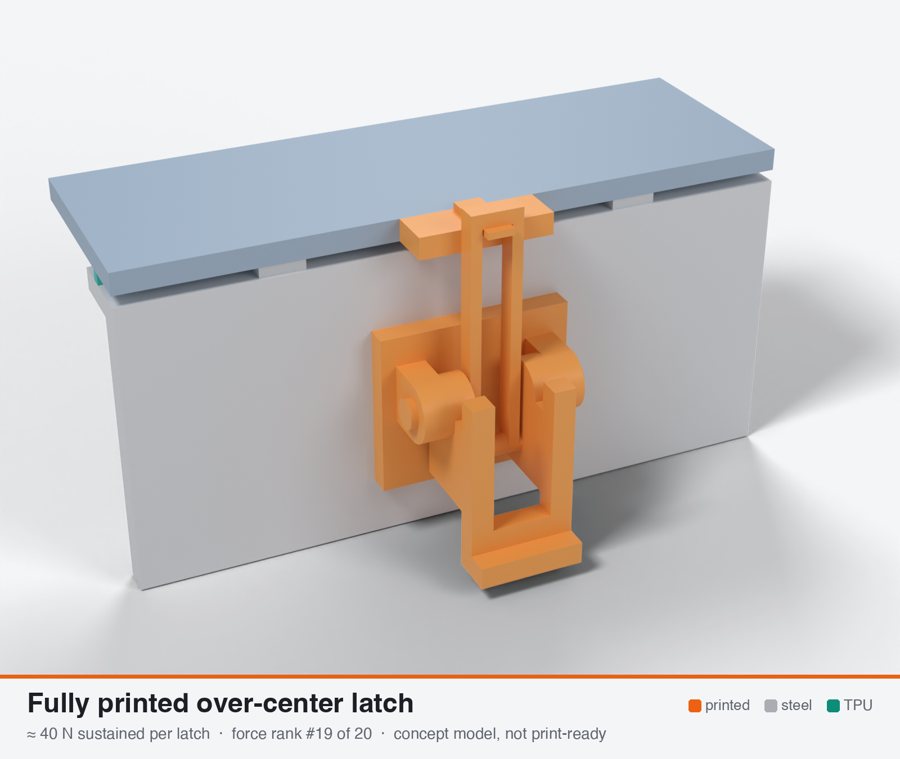
Fully printed over-center latch
Printed posts loaded across layers and C-hook creep limit it (post bending 25-34 N for a 9 mm post standing). Print-in-place posts reach only about 10 N. About 0.46 N/mm with 8 latches. No steel to fix it.
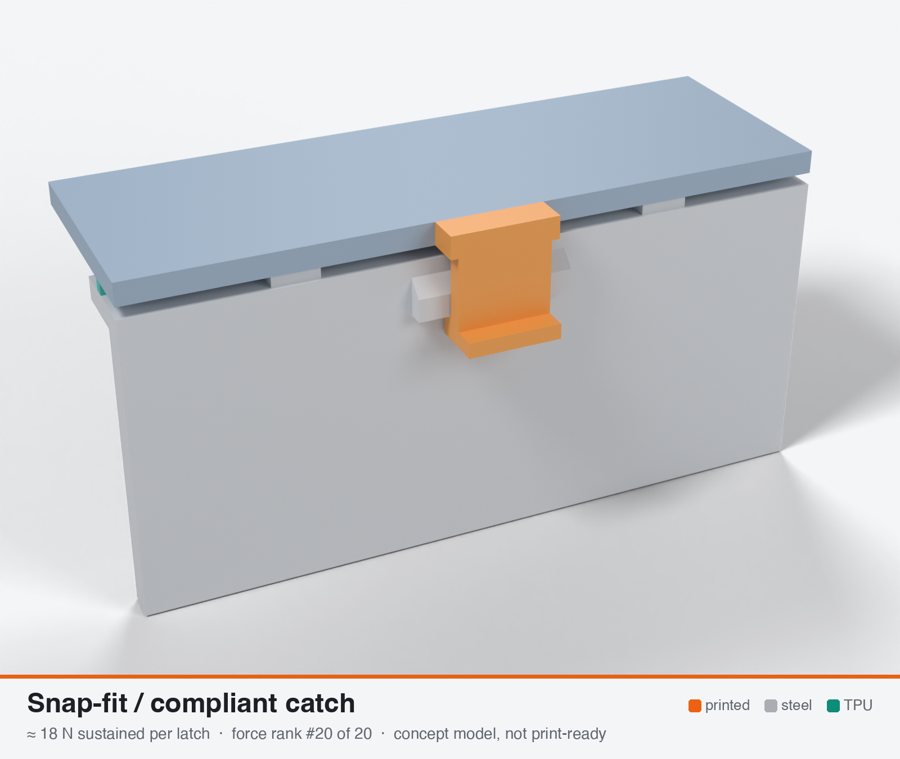
Snap-fit / compliant catch
A rigid snap hook holds about 9-25 N and cannot store preload. The 85A design rib pushes back about 84 N per hook. A TPU strap holds more but relaxes. Useful only as a position keeper beside a real clamp.